
How to keep no-shows from overloading your store managers
Every call-out lands on your GM
When a worker doesn't come in, it lands on the GM. The call comes in on short notice, and they either spend the morning finding cover or run the shift short-staffed and fall behind on everything they were actually hired to do. That happens six or seven times a week, about once a day, at every restaurant. The fix is to solve the reasons people miss work before the shift, so fewer ever reach the GM. Across 7 restaurants, Escalate's McDonald's program prevented 600+ call-outs.
Covering a call-out costs your GM a morning of their own work.
The call comes in on short notice, and it lands on the GM. They ring around for a replacement. If nobody's available they work it themselves and everything they were hired to do waits. That time is part of what a call-out costs (SHRM, UKG).
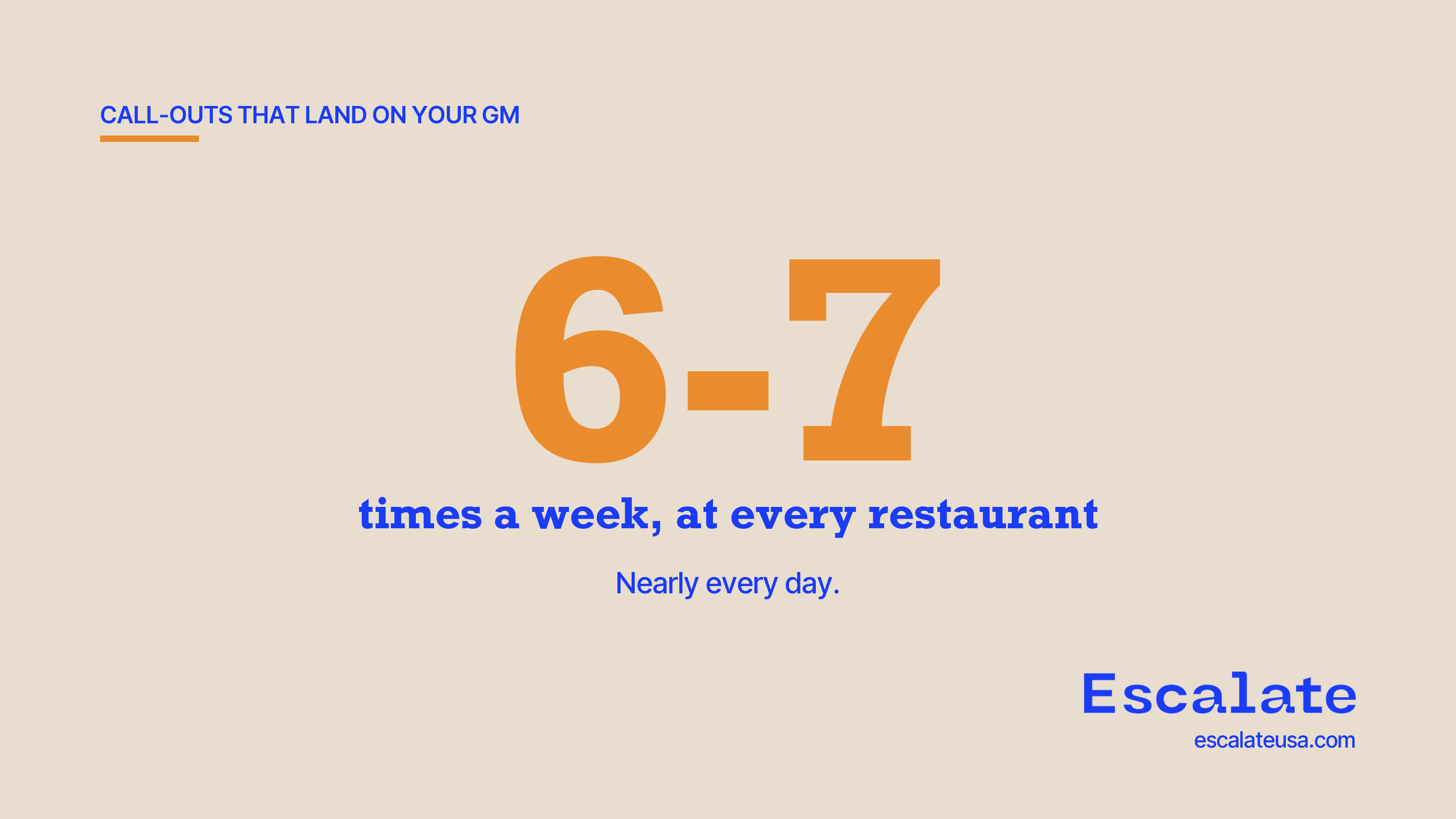
Six or seven times a week, at every restaurant
Call-outs that land on your GM
Six or seven times a week, at every location, a worker runs into something that could cost them the shift, most often a ride that fell through.
That's how often workers asked for help in the Escalate McDonald's pilot. About once a day, per location. Not every one would have become a call-out. But every one was a call the GM didn't have to take, and a morning they didn't have to rescue.
GMs on short notice either run short-staffed or pay for the fix themselves.
The call-out comes at 5am, or in the middle of a rush. Some GMs pay for the ride out of their own pocket, which tells you how few choices they have. Otherwise they work the shift and lose their day, or they run short. None of it solves why the worker was stuck, and none of it can be done twice a week forever.
Ninety minutes earlier, all of it was fixable.
Owners keep call-outs off their managers by fixing the cause before the shift starts.
Attendance is a logistics problem, not a discipline one. You cut call-outs by solving the small things that stop people getting in, and by making sure your GM isn't the one solving them at 5am. Four steps:
Log every call-out and the reason given for a month, then assume "sick" is covering something. Nobody tells the person who writes their schedule that they couldn't afford gas. One cause will still dominate. Here it was rides, at 81% of the top three needs.
Give workers a way to flag a problem that doesn't run through their manager. That's not a nicety, it's the condition for everything else. If the only door is the GM, most people go quiet instead.
The fallbacks have to already exist. Nobody builds a ride option in the 90 minutes before a shift. A ride, a meal, a childcare backup, a same-day telehealth line, standing ready before the call, whenever the call comes. Rides will be four out of five, but you won't know which one this shift needs until it does.
Plan for what you can see coming: weather, school closures.
The aim is to solve it earlier and keep it away from the GM entirely. A coordinated support program is one way to run this. It isn't the only one.
Preventing call-outs cuts your GM's workload.
What the call-out really costs
Two results. The first is coverage: across 7 locations, Escalate's McDonald's program prevented 600+ call-outs, saving about $300,000.
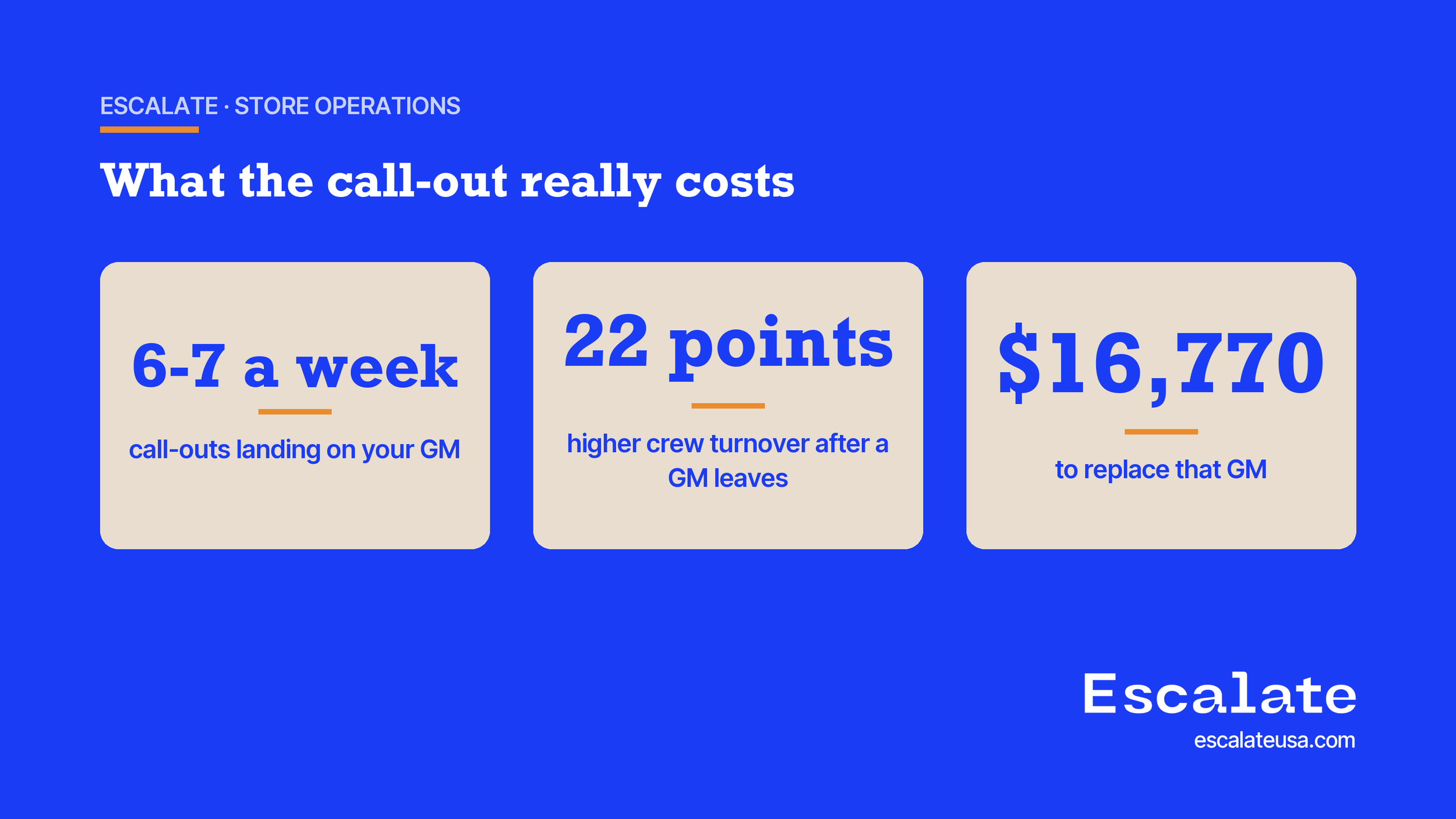
The second is the one nobody counts. A GM who isn't chasing call-outs every day is a GM who stays. That's worth more than it looks. Replacing a crew member runs $2,300 to $2,700. Replacing a GM runs $16,770. And restaurants that keep their GM for at least a year run 22 percentage points lower in hourly turnover than those that don't.
So the call-out has a direct cost. What it does to your GM costs more, arrives later, and never gets named.
Count your call-outs to understand the real burden on your GM.
A call-out affects three people
For one month, have each GM keep a tally: every call-out, how it resolved (cover found, worked short, or paid for the ride out of pocket), and roughly how long it took. Note what got pushed to the next day.
Keep it to a tally. You're asking the person with no time to document having no time, and anything heavier dies in week two.
Then add up the hours. The total usually surprises people, because nothing in your system records it. The shift shows as covered. The GM's morning shows as nothing at all.
FAQ
How do I improve attendance in my locations? Solve the everyday problems that stop people getting to work, and address them before the shift rather than after. Attendance is usually a logistics problem, not a discipline one.
How do I reduce the workload call-outs create for my GM? Solve the problem earlier. Log why people call out, prepare fallbacks for the common causes, and give workers a low-pressure way to flag a problem before their shift, so the GM is not solving it on short notice.
What does a call-out cost? $150 to $450 for a single call-out (SHRM), and $500 or more on a busy, short-staffed shift (UKG). That figure includes the GM's time.
How do I keep good GMs and staff from leaving? Reduce the number of call-outs your GM handles, and fix the barriers behind them. Track first-90-day exits and their reasons, since many early leavers go over problems getting to work, not the work itself, and fix those before the shift. Retention improves when you do. In the Escalate CVS program it reached 93% against the 53% six-month retention target CVS set.
What is the pre-shift window? The 30 to 90 minutes before a shift, when a worker's problem has come up but there is still time to solve it.
References
Escalate program data (McDonald's 7-restaurant dashboard, CVS). Client-provided.
SHRM, cost of absenteeism and replacement.
UKG, cost of an understaffed shift, including management time.
