



You cannot fix a call-out you never understood, and what your system recorded is usually not what happened.
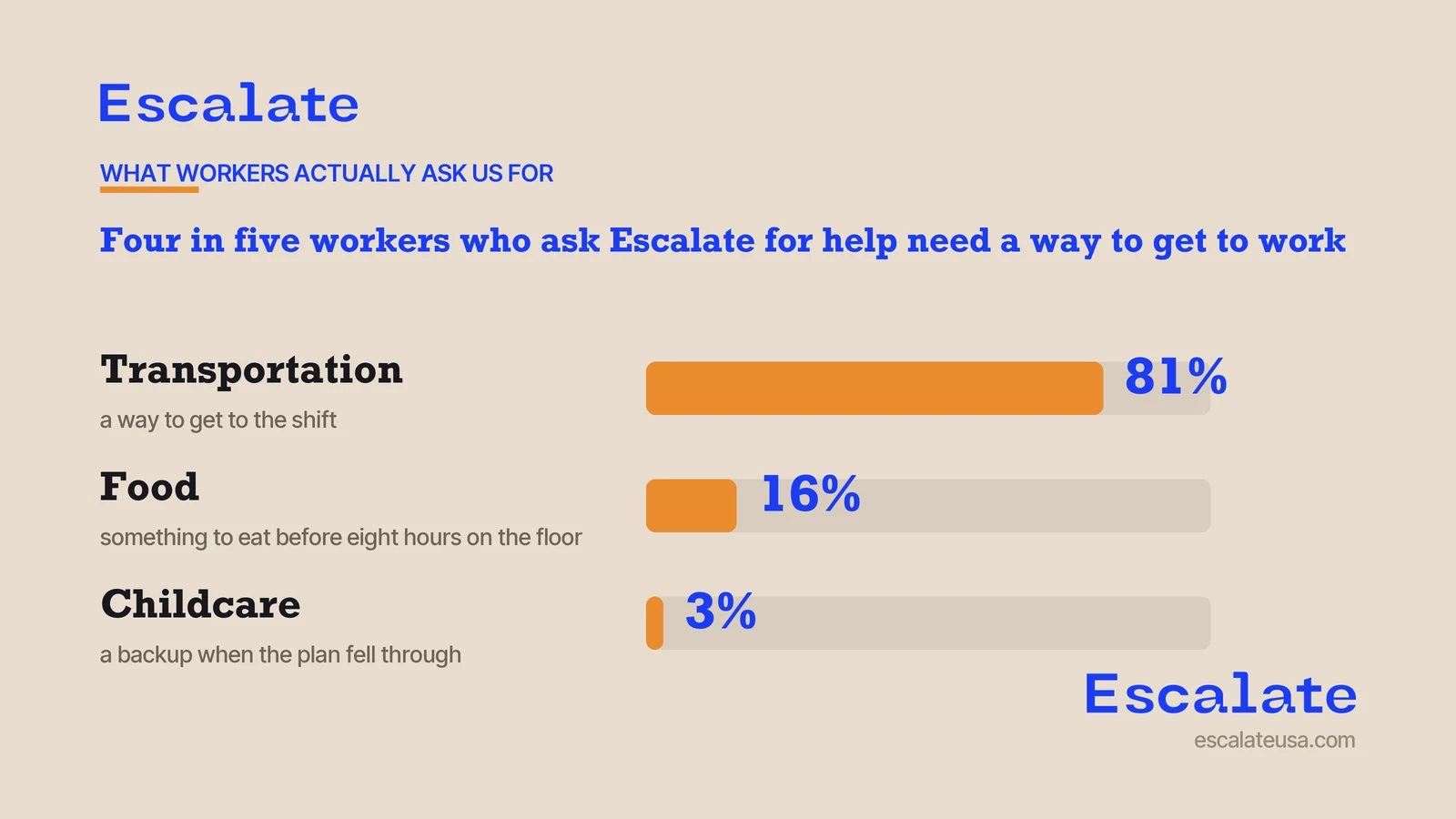
In the programs we run, transportation is the ask in 81% of requests, food in 16% and childcare in 3%. Most employers we talk to name childcare first.
That gap is not workers being evasive. People keep the real reason to themselves when they believe honesty may count against them, which is the dynamic Amy Edmondson studied as team psychological safety.
The barrier your crew names most often is also the one that shows up in national data. A 2024 study in Regional Science and Urban Economics found that commuting costs explain roughly 2 to 4 percentage points of the unemployment rate for people with at most a high school degree. Not two percent of the rate. Two to four points of it.
Spend against the reasons already sitting in your records and you will fund the wrong thing. Below are five ways to get closer to the real ones, and none of them need new software.
The right support depends on knowing what actually stopped the worker
A worker who cannot reach a shift is dealing with one specific obstacle that day. A car that will not start. A bus that did not come. No money for gas until Friday. Nobody to watch the children. Help that matches the obstacle gets that worker to the next shift. Help aimed anywhere else costs the same money and gets nobody to work.
The worker absorbs it first. Someone who cannot get to a shift for want of a ride loses that day’s pay, and their household is short before anything reaches your reports. What you see arrives later, as empty shifts, overtime to cover them and people leaving.
Help with transportation is 81% of what workers ask us for. Childcare is 3%.
We see the gap because workers bring the problem to us in their own words, instead of to their manager. Four out of five times it is about getting there.
| Barrier | How most operators we talk to rank it | Share of what workers ask us to help with |
|---|---|---|
| Childcare | Named first | 3% of requests |
| Transportation | Usually named second | 81% of requests |
| Food and money worries | Rarely named at all | 16% of requests, for food |
Childcare problems are real, and for the families they affect they are severe. A 2011 study in Academic Pediatrics surveying 1,431 households with a working parent found that 21% had missed work and 27% had changed their schedule because of childcare. Single-parent households were significantly more affected.
Our numbers look different for two reasons. We hear from every worker, not only parents. And a childcare gap is usually known days ahead, so it becomes a scheduling conversation. A car that will not start at 5 a.m. is not. What reaches us is what breaks on the day, which is the category no roster can absorb.
Yet the barrier most operators name first, childcare, is the one workers ask us about least.
So the operator working from that ranking funds the wrong thing, negotiating backup childcare while the crew is trying to find a ride. Find out what your people actually need, and give them more than one way to tell you.
Workers keep the real reason to themselves when they believe it may count against them
Amy Edmondson introduced the idea of team psychological safety. Studying 51 work teams at a manufacturing company, she found that where people believe speaking up is safe, they discuss errors, ask for help and raise problems, and those teams perform better. Where they do not, the problems stay quiet. She published the finding in Administrative Science Quarterly in 1999, and psychological safety has since become one of the most cited ideas in organizational research.
Her teams were withholding mistakes from each other, not call-out reasons from a manager. But the calculation is the same one: you do not hand someone a problem when you think they might count it against you. An hourly worker deciding what to put in a call-out text is running exactly that calculation, and the stakes are more concrete than embarrassment. Attendance points. Fewer hours next week. A reputation as unreliable.
So a drop in reported problems is not evidence of fewer problems. It can just as easily mean people stopped telling you.
Your reason field records what people were willing to say
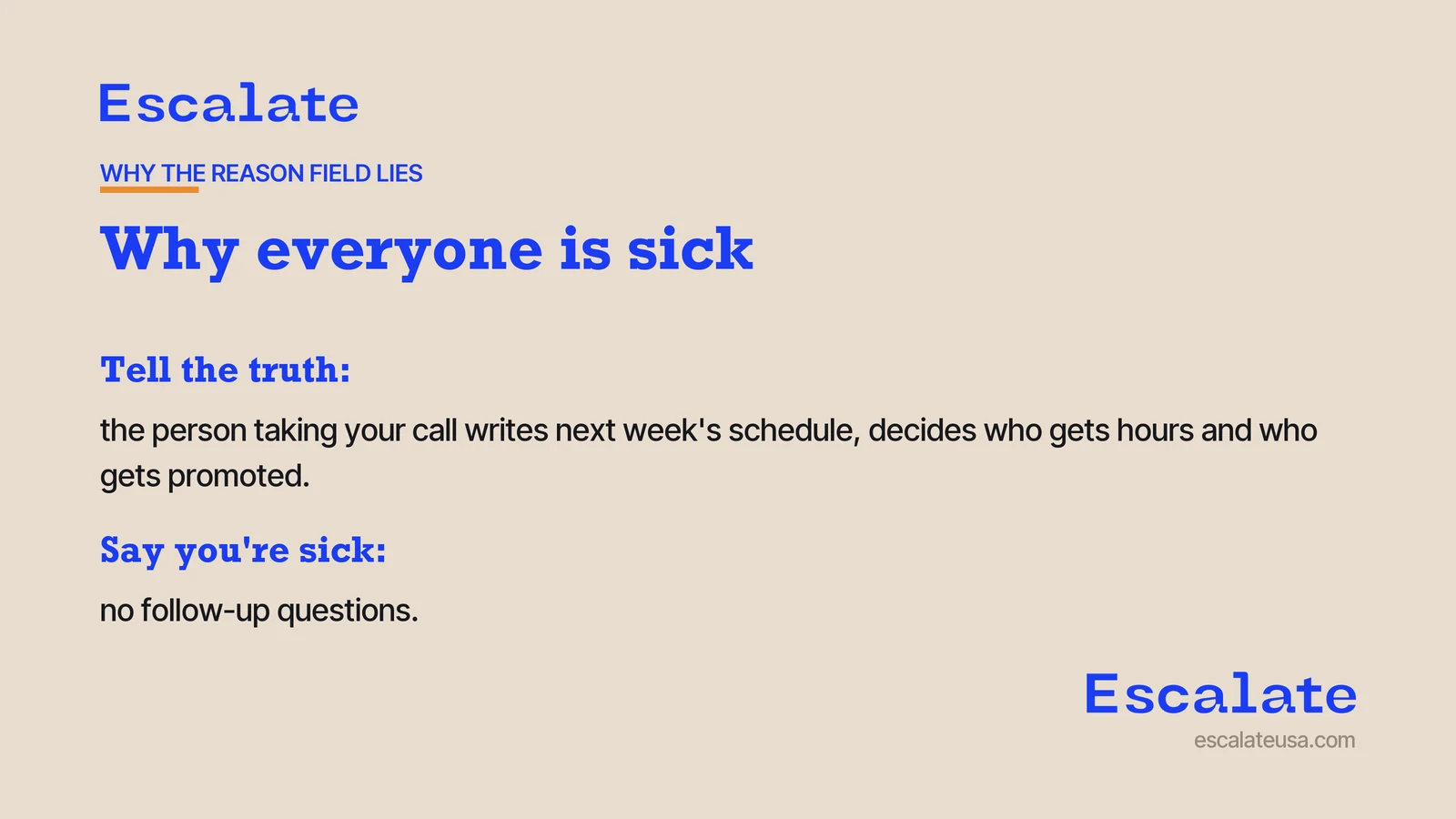
Your call-out data is a record of what people were willing to tell you, not of what happened. Sick is the safe answer, because the manager who takes the call also writes next week’s schedule, decides who gets hours and puts people forward for promotion. Telling that person you could not afford gas until Friday is telling them something about you. Telling them you are sick ends the conversation.
So the reason field fills up with the one answer that invites no follow-up, and you build your benefit spend on it.
Your call-out log still tells you plenty. When absences happen, how often, which shifts, which people. What it does not tell you is why, and why is the only part that determines what to fix.
That matters because those entries are already deciding things: where the support money goes, which shifts get watched and how a manager handles the next call. You are making real decisions on the one field that is least likely to be true.
So this comes before any program you build. Not better data entry, since workers are answering sensibly given who is asking. What has to change is who is asking, and what it costs them to answer honestly.
Commuting costs explain 2 to 4 points of the unemployment rate for workers with at most a high school diploma
The independent research on transportation reaches the same conclusion from a different direction, which matters when a vendor is quoting you its own numbers.
- A 2012 assessment of job access transit programs, drawing on a review of 140 welfare-reform studies, found transportation cited again and again as a reason people could not start work, had to stay on public assistance, or had to quit a job they had.
- When a worker has a car, they find work more easily, stay with an employer longer and earn more. Living near a bus or train helps, but not nearly as much.
- A 2024 study in Regional Science and Urban Economics found that commuting costs explain roughly 2 to 4 percentage points of the unemployment rate for people with at most a high school diploma. Points of the rate, not a fraction of it.
- The median worker earning under twice the federal poverty line spends 6.1% of income getting to work. Above that line, the median is 3.8%.
Money worry lowers the output of people who do come in
Kaur, Mullainathan, Oh and Schilbach ran a field experiment with 408 manufacturing workers in Odisha, India, published in the Quarterly Journal of Economics in 2025. They staggered when wages were paid, so on a given day some workers had cash and others were still short. Those who got paid immediately settled debts and bought household essentials. Their work then changed in three ways.
- Output rose 7%.
- Costly mistakes fell, so they worked faster and more accurately at once.
- The effect concentrated among the workers in the sample who were most short of money.
The researchers ruled out the obvious explanations. Not gratitude, not better food. What changed was attention. A worker turning over how to cover rent is not fully at the task in front of them, and that is not a motivation problem you can manage your way out of.
The setting is a real limit, and the authors are clear about it: piece-rate factory work in India, not a store in Ohio. But the underlying pattern is not exotic. Americans report losing roughly 6.4 working hours a week to thinking about money. Treat the mechanism as transferable and the exact percentage as belonging to that factory.
Where sick pay is absent, the recorded reason tells you even less
Studies of paid sick leave laws agree on one result: once workers get paid sick days, fewer of them come to work while they are sick.
For an operator this is about your own records, not about policy. Where there is no sick pay, saying you are sick earns a worker nothing. It costs them the same day’s wages as any other reason would. And they say it anyway, which tells you what the word is actually for. Saying you are sick is the answer that ends the conversation.
Meanwhile the genuinely ill are coming in, because they cannot afford not to. So your log undercounts illness and overcounts it as a reason at the same time, and neither error is visible from inside the data.
Five ways to get closer to the real reasons
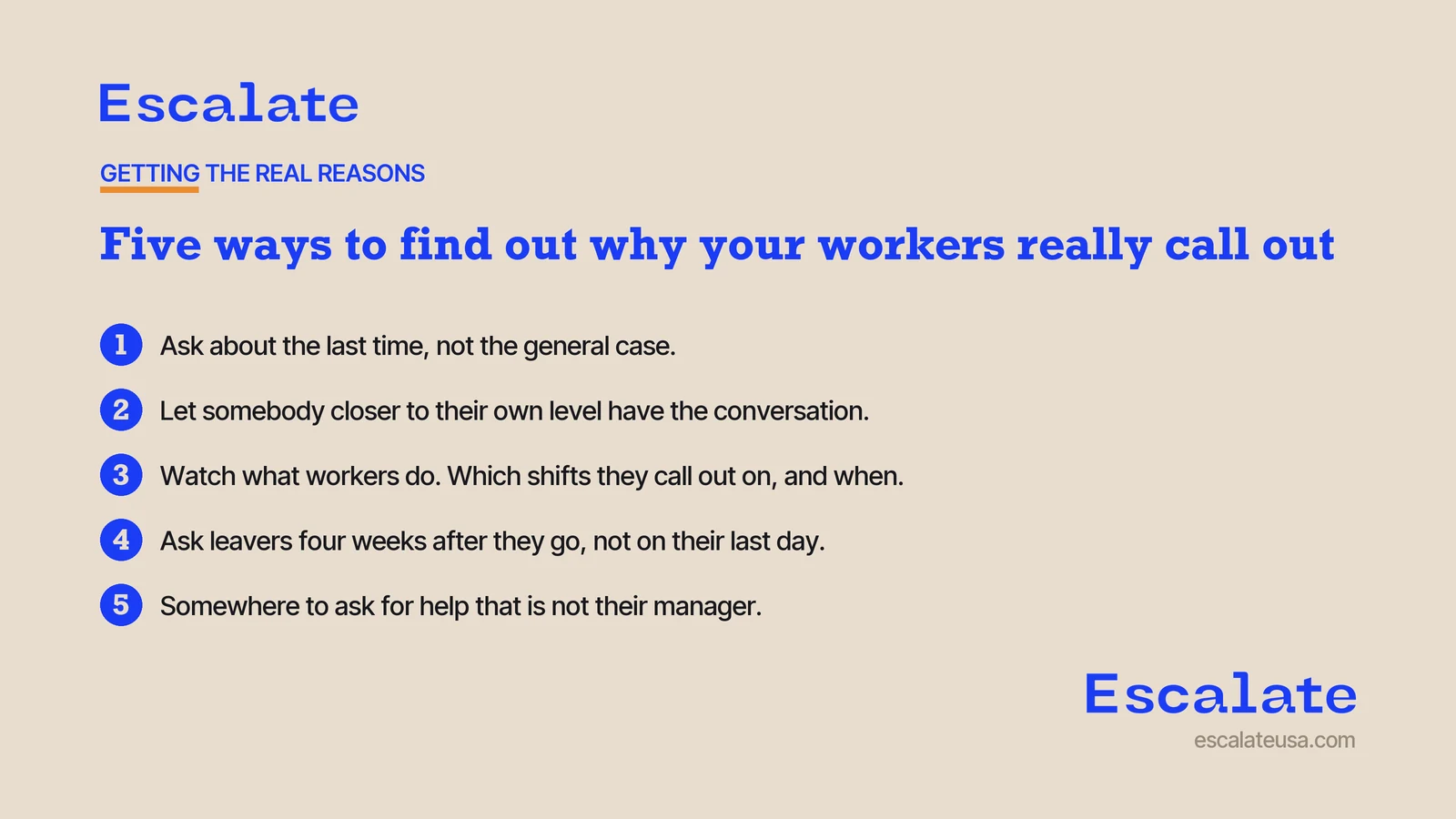
1. Ask about the last time, not broad questions. If you ask, “What happened the last time getting here was difficult?” you will get a real answer. If you ask, “What stops you from getting to work?” you will get a polite, empty answer. A broad question makes people give a broad answer, and they will choose the safest option.
2. Let someone closer to their level talk to them. Workers say more to a peer than to whoever decides their hours. A crew trainer or a worker who has been with you for a long time will learn things a manager never will. These facts are just as helpful when you hear them second-hand without attaching any names.
3. Watch what workers do, not what they say. Look at which shifts workers call out on, and at what times. When your call-outs cluster on early openings and on the last few days before payday, you are looking at travel and money, no matter what the reason field says.
4. Ask workers why they left four weeks after they go, not on their last day. On their last day, workers still want a good reference, so they will give you a safe answer. A month later, they have a new job and no reason to hide anything. If you send a short message with one honest question, they will usually write back.
5. Give workers somewhere to ask for help that is not their manager. This is how our own program works, so we want to be open about our interest. Workers will tell an independent person things they will never tell the company that pays them, and you get the pattern back without attaching any names. Any arrangement like this will work, and it does not have to be us.
Better data changes three decisions you already make
Where you spend. The guessed list and the real list point at different spending. Check your benefit budget against what your crew actually tells you before the next renewal.
Which shifts you watch. Look at whether your call-outs cluster by person or by time of day. Clustering by person is an individual situation. Clustering by shift is usually structural, and openings and closings are the ones to check first, since they sit outside both transit hours and childcare hours.
How your managers respond. A manager who believes a worker did not want to come in manages that worker out. A manager who knows there was no ride solves a ride. Same absence, same worker, two different rosters six months later.
Questions operators ask
Is it not simpler to make the reason field mandatory?
Forcing an answer changes what managers write rather than what is true. A required field with a dropdown produces more “sick”, because the safest option is still the safest option.
How do I ask without it feeling like an interrogation?
Ask about the trip, not the call-out. “What would make getting here easier?” is a question about the trip to work. “Why were you off?” is a question about the person.
Should I tell my crew I am collecting this?
Yes, and tell them why you are doing it. Workers answer differently when they know you want to fix schedules or help them find rides, rather than build a case against them.
What if the real reasons turn out to be things I cannot fix?
Some will be. But when four in five of the requests we receive are for help getting to work, you still know where not to spend. Knowing where not to spend makes the exercise worth doing.
How often should I redo this?
Do it once a year. Also do it whenever you change your store locations, change your shift times, or when the city changes its bus routes. The mix is specific to a place, and it changes when the place does.
Sources
- Edmondson, “Psychological Safety and Learning Behavior in Work Teams”, Administrative Science Quarterly, 1999, 44(2). Link
- Kaur, Mullainathan, Oh and Schilbach, “Do Financial Concerns Make Workers Less Productive?”, Quarterly Journal of Economics, 2025, 140(1). Link
- Sergeyev, Lian and Gorodnichenko, “The Economics of Financial Stress”, National Bureau of Economic Research Working Paper 31285, 2023. The source of the 6.4 hours a week figure, as cited by Kaur and colleagues. Link
- Abrahams and Mabli, “Commuting barriers to low-wage employment”, Regional Science and Urban Economics, 2024, volume 104. Link
- Thakuriah, Persky, Soot and Sriraj, assessment of job access transit programs, Evaluation and Program Planning, volume 37, 2013 (online 2012).
- Roberto, “Commuting to Opportunity: The Working Poor and Commuting in the United States”, Brookings Institution Metropolitan Policy Program, February 2008. The source of the 6.1% and 3.8% figures. Link
- Urban Institute on transportation and opportunity. Link
- Richmond Fed district digest on commuting costs. Link
- Montes and Halterman, national survey of US parents on childcare problems and employment, Academic Pediatrics, 2011, 11(1). Link
- Paid sick leave evidence, Journal of Human Resources. Link
- Escalate program data. Workers ask for help with transportation in 81% of requests, food in 16% and childcare in 3%.