




Scheduling enough people for your busiest hours protects your crew and keeps your sales up, and it is usually the cheapest change a store can make.
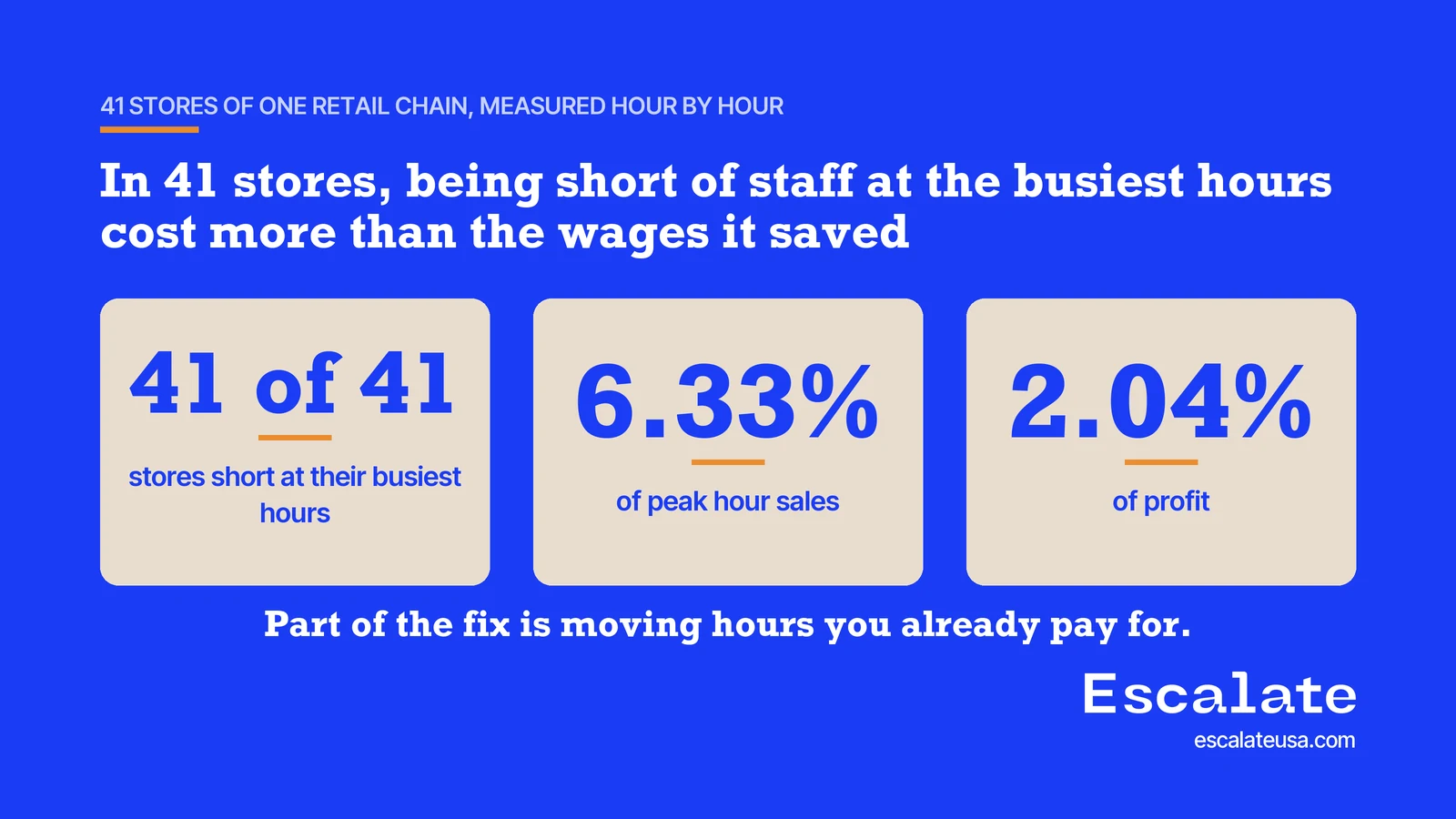
Researchers studied 41 stores of a large retail chain and found every one was short-staffed during its three-hour peak. The 41 stores lost 6.33% of the sales they could have made in that window. The same stores scheduled more people than they needed during quiet hours, which cost them a separate 2.04% of profitability.
Neither loss appears on your weekly reports. A customer who waits too long leaves without buying, and your point of sale system never records a sale that did not happen.
Your crew absorbs the difference, and that cost has been measured too. When a manager asks a server on the day to work past the end of their shift, that server stops suggesting extra dishes, and the value of what they sell falls by 4.4%.
You can find your own busy period this week from two records you already have, and the first fix is usually transferring hours you already pay for rather than buying new ones.
Every store in the study was short-staffed at peak. All 41 of them.
Mani, Kesavan and Swaminathan gathered hourly records of customer traffic, sales and labor hours from 41 stores of a large retail chain, and published the study in Production and Operations Management in 2015.
Every store in the sample ran short during its three-hour peak. Not most of them. All of them.
Rosters get written in blocks that start on the hour and divide the day evenly, while customers arrive in rushes. A store that puts the same number of people on every hour has the right headcount on average, too many when it is quiet and too few when it is busy. Those 41 stores had staff on shift they did not need in the slow periods while running short in the busy ones, which points to reallocating hours before adding them.
There is a simpler reason this persists in well-run businesses. Somebody reports labor cost every week, so a manager can see that number and act on it. Nothing reports the sales lost during a rush. One side of the trade is measured and the other is invisible, and managers optimize what they can see.
Managers miss the rush for one of three reasons, and each needs a different fix
Forecasting error. The manager did not expect the rush, so they wrote the schedule for a quieter day.
Scheduling constraint. The manager expected the rush and still could not get anyone on the floor for it. Shift lengths, who was available, break times and handovers all sit between a correct forecast and a matching roster. The busy period arrived at the same time every day and the shift times still could not change.
These first two are the causes the study names. The third comes from what we see in the programs we run, not from the study.
Coverage failure. The manager forecast correctly, built the right roster, and someone did not turn up. This is the version most operators live with and the one most likely to be missing from the discussion, because it is not a planning problem at all. It happens on the day, and it is the only one of the three you can do something about this week rather than this quarter.
The distinction matters because the three call for different responses. Better prediction fixes the first, since there the manager only needed to know the rush was coming. The second needs the schedule template changed, which is slower and usually requires someone above store level. The third needs a way to fill a gap after the schedule is already set.
Most owners assume their forecast is the problem. The forecast usually is not the problem. If a manager already knows when the rush happens, showing them the pattern more clearly changes nothing.
Whichever of the three it is, you arrive at the same question. How many people do you actually need during each hour of the day?
During the rush, an extra person brings in more than they cost
Every hour of the day has a point where the cost of one more worker matches the sales they bring in. During a rush most stores sit below that point, so adding a person brings in more than their wage. During quiet hours most stores sit above it, so adding a person does not. The same decision makes sense at one time of day and wastes money at another. When your people work matters more than how many you employ.
This is only true if the extra person can actually be used, which is a condition worth taking seriously and one we come back to below.
The chains that staff above the minimum outperform the ones that do not
Zeynep Ton at MIT has spent years on retailers that schedule more people than the work strictly requires. Costco, Trader Joe’s, QuikTrip and Mercadona all run with more staff on the floor than their direct competitors, and all four outperform them on measures like sales per square foot and labor productivity. Her account is that the staffing is what makes the rest of the operation work. A crew with enough people finishes what the shift requires. A crew running short does not, so shelves stay empty, orders run late and customers notice.
Ton also explains why managers keep under-scheduling the busy hours anyway. When the pressure is on to bring wage spend down, hours are the one line a store manager can change this week. The cost of changing it arrives weeks later as softer sales and people quitting, and no report connects either back to the roster that caused them.
When the rush is short of staff, your crew feels it before your sales do
When more customers arrive than you scheduled for, the people on shift absorb the difference. The manager asks a server to stay past the end of their shift, or leaves one cashier on a long queue while boxes of stock sit unpacked on the floor. Neither shows up as a cost on any report, which is exactly why managers reach for them.
Kamalahmadi, Yu and Zhou measured what the first decision costs. Writing in Management Science, they tracked nearly 1.5 million transactions over nine months across 25 restaurants of a casual-dining chain that operates more than 500 nationally. A server asked on the day to stay past the end of their shift stops suggesting extra dishes, and the value of what they sell falls by 4.4%.
The important part is what did not produce that drop. Servers told about a schedule change two days ahead showed no loss of productivity. The damage is not in the extra hour. It is in finding out about it with no notice. So the same-day ask costs you twice: you pay the wage, and you take less money than you would from somebody who knew on Tuesday they were working it.
The second loss arrives weeks later. Choper, Schneider and Harknett followed 1,827 hourly retail and food service workers over time and found that schedule instability strongly predicts who actually leaves, with the effect concentrated among the roughly one third of workers whose schedules were least stable. Just under half of that relationship runs through job satisfaction and another quarter through the difficulty of fitting an unpredictable roster around family life. Both of those are visible to a manager long before anybody resigns.
Heskett, Jones, Loveman, Sasser and Schlesinger gave this pattern a name in 1994. They called it the service-profit chain: how a business runs its shifts shapes how people feel about the job, how they feel shapes how they treat customers, and that shapes whether customers come back. It was a framework rather than a finding, but the middle of it has since been tested. Harter, Schmidt and Hayes examined 7,939 business units across 36 companies and found that where staff were more satisfied and engaged, customers were more satisfied, productivity was higher, profit was higher, turnover was lower and there were fewer accidents.
None of this is one study confirmed three times. They are different literatures, using different methods, pointing the same way. That is a weaker claim than a single decisive result and a more durable one.
How your crew is treated on shift and how much your store earns are the same subject. The worker who covers a rush without enough help pays for that roster first, and their family pays at home.
More people on the floor only helps if the work is set up for them
Scheduling more hours only brings in more than it costs when the work is organized to use the extra help. Add somebody to a shift without clear instructions, training or the authority to decide anything, and you have added a body to the floor without serving one more customer. Ton names four operating choices that determine whether more staff produces more sales.
- Focus and simplify. Sell fewer products, run fewer promotions and assign fewer unusual tasks, so the crew can finish more inside a shift.
- Standardize and empower. Make sure routine tasks are done the same way every time, then let people handle everything else without asking a manager first.
- Cross-train. Train each person on several tasks and a call-out has three possible fills instead of one. Quiet hours become the time somebody learns a new skill.
- Run with slack. Roster above the bare minimum, so the crew has time to serve customers, unpack stock and fix problems as they happen.
Cross-training is what turns the quiet hours from waste into investment, and it is the one that speaks directly to the coverage problem. A crew where three people can run the register is a crew where one absence is a nuisance rather than a shortfall. The slow stretch that looks like idle wages on a chart is when that training happens, along with unpacking stock and prep work that would otherwise fall in the middle of a rush.
So transfer some of those quiet hours into the busy ones, and give real work to whoever covers the hours that stay.
Quest Diagnostics, Sam’s Club and Mud Bay have since adopted the same approach. All three report that fewer people quit, sales increased and more work got done inside a shift. So the approach is not limited to those first four chains.
Two records you already have will show you your busy period
None of these studies tells you where your own store loses money. Finding that out takes two records you already have.
- Export hourly sales for one store for one full week. Every point of sale system will do this.
- Export labor hours for the same store and week. Scheduled hours work. Clocked hours are better.
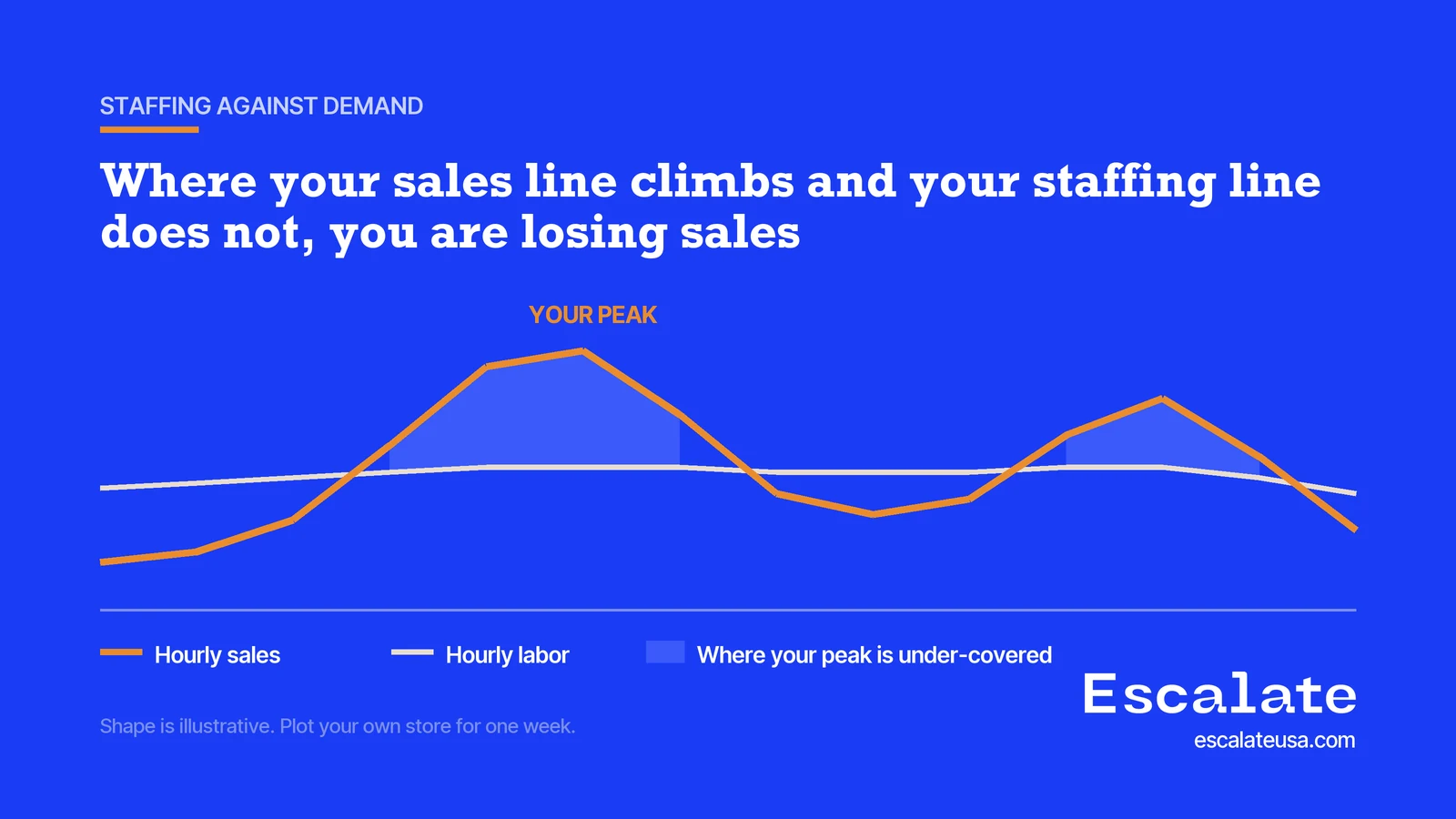
- Plot both against hour of day, sales on one axis and labor hours on the other, so the two lines are readable together.
This is a rough field version of what Mani and colleagues did, not their method. They had hourly customer traffic, and traffic is the variable that does the work. It is what separates a quiet hour from a busy hour the store failed to serve. Sales cannot tell those apart, because the customer who saw the queue and left is not in the sales line.
So be clear about what this chart shows you. It shows when your store is busy, and it shows where you are paying for hours you could move. That is enough to act on, and for most stores it is the first real look they have had at their own shape of demand. What it will not show you is the size of the shortfall, or the coverage gap you never filled. Those are still invisible, which is the whole problem.
If you already have door counters or drive-thru timers, use them. Most operators have more traffic data than they think and have never put it next to a labor line.
Your busy period will not necessarily fall where the study’s did. Expect it whenever your customers actually arrive.
Four patterns on the chart tell you what to change
| What to look for | What it means |
|---|---|
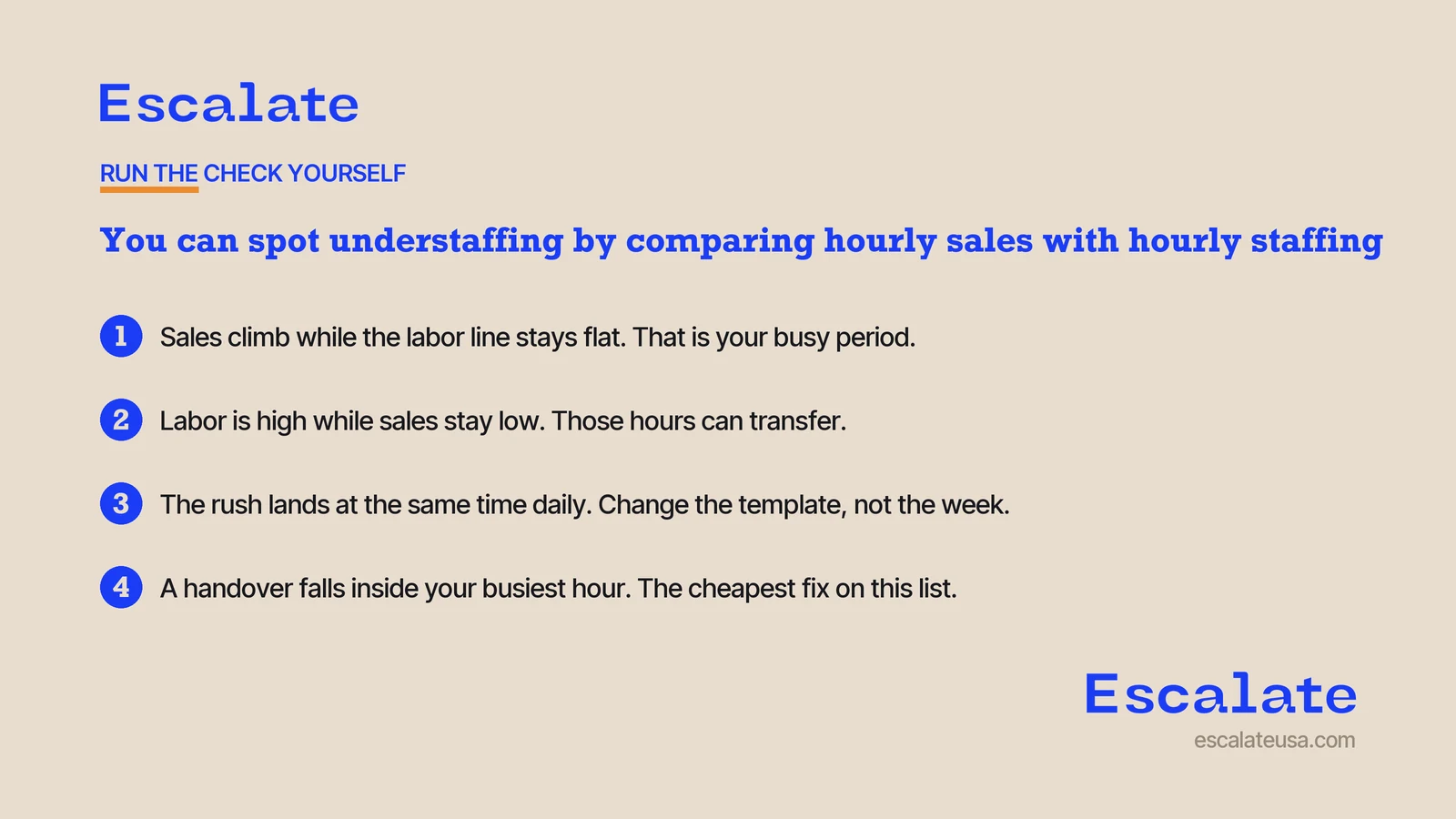
| Sales climb while the labor line stays flat | Your busy period, and where you are likely short |
| Labor is high while sales stay low | Hours you can transfer to a busier time |
| The rush happens at the same time every day | Change the schedule template permanently, rather than deciding again each week |
| A handover falls inside your busiest hour | The cheapest problem on this list to fix |
Managers put handovers inside the busiest hour more often than owners realize. For those minutes two people are half out of service, because one is finishing up while the other is still working out what is happening on shift.
Reading the chart takes minutes and needs no training in statistics. You only compare the two lines hour by hour, using records you already have.
Transferring hours you already pay for is the cheapest place to start
Transfer hours before you add them. In most stores the weekly wage bill stays the same, because you are only changing when the shifts fall. Trying the change therefore costs you nothing.
Set shift start times to match customer arrivals rather than the clock. If your rush begins at 11:30, do not start a shift at noon.
Do not change shifts during the busy hours. Starting or ending fifteen minutes either side of the rush is usually enough.
Take breaks and closing chores out of your busiest hour. Whoever would normally step away stays on the floor while sales are climbing.
Check customer arrivals day by day, not only week by week. Saturday rarely matches Tuesday, so one template will be wrong on at least one of them.
Give your crew the new roster as early as you can. People value knowing their shifts in advance, and unpredictable shift times are what the research on quitting points to.
Draw the chart again in a month. Customer arrivals repeat in the same pattern, so this becomes a habit rather than a one-off exercise.
Labor percentage measures how much you spent, not when you spent it
Your labor percentage limits what you can spend on wages, and nobody is telling you to ignore it. What these studies change is where you look when the pressure is on to bring it down.
Cutting shift hours changes that percentage fastest, which is why managers cut. The cost arrives weeks later as softer sales and people leaving, and nothing on the report connects either back to the roster.
Moving hours from a quiet stretch to a busy one does not change the percentage at all. Same total wage bill, same denominator, same number at the end of the week. It is the one improvement available to a manager whose labor budget is already fixed, which is most of them.
That is the practical argument in this whole article. You are not being asked to spend more. You are being asked to spend the same money at different hours.
So pull last week’s hourly sales and your crew’s hours, put them on one chart this afternoon, and find the stretch where you have more people on shift than the hour needs. The hours in that stretch are the hours to move.
Questions operators ask
How many weeks of records do I need before I can trust the pattern?
One week shows you when customers arrive. A month tells you which parts of that pattern repeat. Start with one week, because the busiest three hours are usually clear enough to act on straight away.
My point of sale system will not export hourly sales. What should I do?
Count receipts by hand for three days, during the hours you think are busiest. A rough count is accurate enough, because you are looking for the shape of the day rather than an exact figure.
Does any of this apply to a business where the same number of customers arrive every hour?
Stores and restaurants are rarely flat once you look at arrivals hour by hour. If your chart does come out level, the exercise cost you one afternoon and ruled out a common problem.
Should I raise total hours or only transfer them?
Transfer first, then measure. Many owners find they can cover the rush without raising the wage bill at all. If you can show what moving the shifts earned, you have a much stronger case for spending more.
What do I tell my crew when the schedule changes?
Tell them what you found and why the shift times are changing. People accept a change more easily when they understand the reason. They will also tell you where the new roster fails, because they are the ones working it.
What if my managers object because their bonus depends on keeping wages below a set percentage of sales?
The target is the problem, not the manager. Anyone paid on a percentage will protect that percentage. Measure them on sales per labor hour instead, which improves when the shifts sit in the right hours.
Sources
- Mani, Kesavan and Swaminathan, “Estimating the Impact of Understaffing on Sales and Profitability in Retail Stores”, Production and Operations Management, 2015, 24(2), pages 201 to 218. Link
- Kamalahmadi, Yu and Zhou, “Call to Duty: Just-in-Time Scheduling in a Restaurant Chain”, Management Science. Link
- Choper, Schneider and Harknett, “Uncertain Time: Precarious Schedules and Job Turnover in the US Service Sector”, ILR Review, 2022, 75(5). Link
- Ton, “The Effect of Labor on Profitability: The Role of Quality”, Harvard Business School working paper, 2009. Link
- Ton, The Good Jobs Strategy (2014) and The Case for Good Jobs (2023). Link
- Heskett, Jones, Loveman, Sasser and Schlesinger, “Putting the Service-Profit Chain to Work”, Harvard Business Review, March-April 1994. Link
- Harter, Schmidt and Hayes, Journal of Applied Psychology, 2002, 87(2), pages 268 to 279. Link