
Podcast guest
Sean Segal makes the business case for putting frontline workers first.
Sean talks with hosts about what call-outs cost employers, and how helping workers get to their shift keeps them in the job.

Sean at a glance
Now
Cofounder and chief executive, Escalate
Before
Founding chief executive of Generation in the United States, which grew to a $30 million budget in four years
First job
Teacher in a low-income community
What drives Sean
Sean wants every frontline worker to keep the job they worked hard to get, and every employer to see that helping those workers is good business.
As seen on

As heard on

Watch and listen
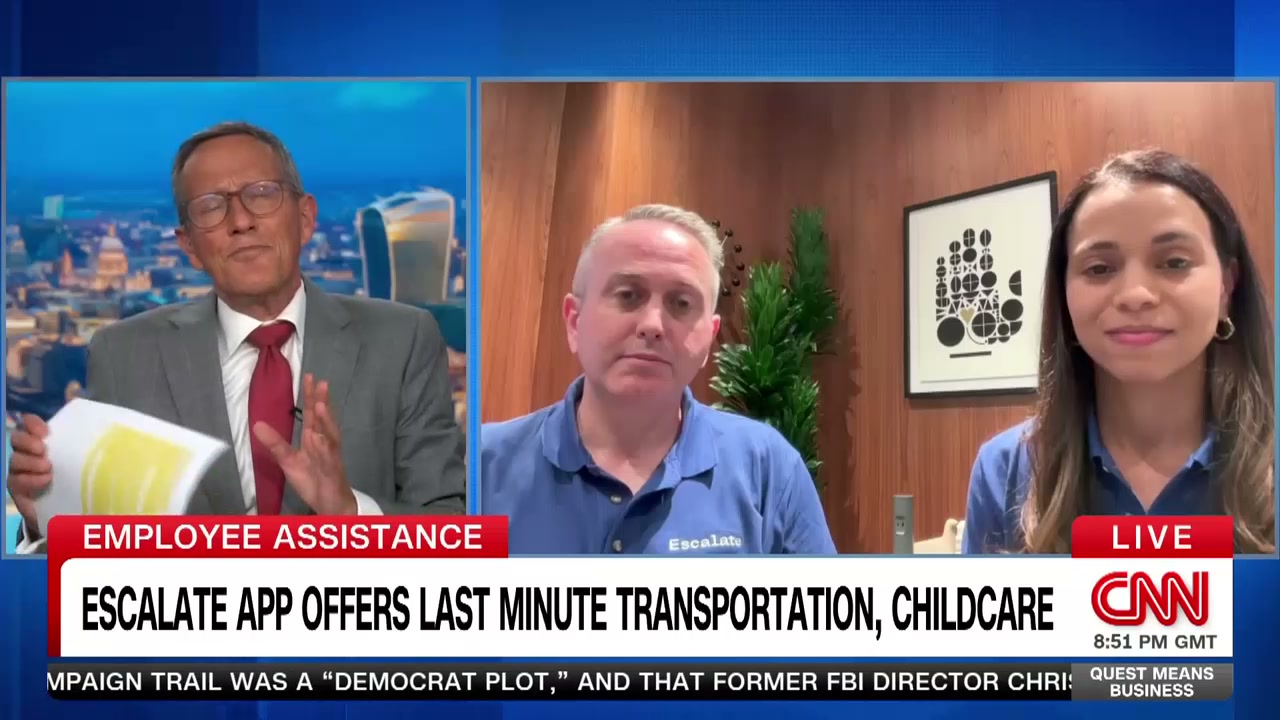
Watch Sean on CNN and hear the NPR story about Escalate
Listen
All Things Considered, NPR, August 17, 2026. Four minutes and 58 seconds.
Pressing play loads a player from npr.org, which sets its own cookies. Nothing is requested from NPR until you press it.
Escalate’s pilot results give hosts real numbers to discuss
About Escalate
Escalate helps hourly workers through the moments that stop them getting to a shift
Many call-outs among hourly workers start with something outside the job: a bus that runs late, a flat tire, a relative who usually watches the children and cannot come today. Escalate helps workers through those moments in the short window before a shift, through a simple chat with a real person who answers around the clock. Workers get to their shift, and employers keep the people they hired.
Topics
Sean talks about four ways employers keep frontline workers at work
People keep a new job when someone helps with the ride, the childcare and the money.
At Generation, many of the people placed in new jobs lost them within about 90 days. When Sean and Sienna asked why, the answers were a ride, childcare or money, and almost never a missing skill. That finding is why Escalate exists.
Preventing a call-out costs an employer far less than the call-out itself.
A single call-out costs a restaurant about $350 in overtime paid to someone else, slower sales and the manager’s time. Sean explains why a small, fast support that gets a worker to their shift gives an operator such a clear return.
Employee support lasts when it is built as a business case.
Sean saw workforce programs funded by philanthropy treated as charity. He built Escalate so that helping workers shows up on the employer’s bottom line, which is what keeps the help going.
Technology works best for frontline workers when a real person stays on the other end.
Escalate uses live and AI coaches to answer workers fast, and every worker can reach a human. Sean argues that entry-level jobs are a route to a living wage, and that the practical problems stopping people from getting to work can be solved today.
Invite Sean to talk about keeping frontline workers at work.
Tell us the name of your show, the topic you have in mind and your preferred dates.